
Research
My research sits across immersive media, digital culture, identity and creative practice, with a particular interest in how people use technology to represent themselves, tell stories and make sense of lived experience.
Much of my work explores voices, experiences and histories that can be overlooked or difficult to represent through conventional forms. I'm interested in how immersive and digital technologies can create different ways of documenting, experiencing and sharing these narratives, particularly through co-creation and practice-based research.
My research brings together qualitative methods and creative practice, including immersive media, film, visual storytelling and oral history. Across these different approaches, I'm interested in the relationship between people, culture and technology, and in how creative research can generate both new knowledge and meaningful experiences for the communities involved.
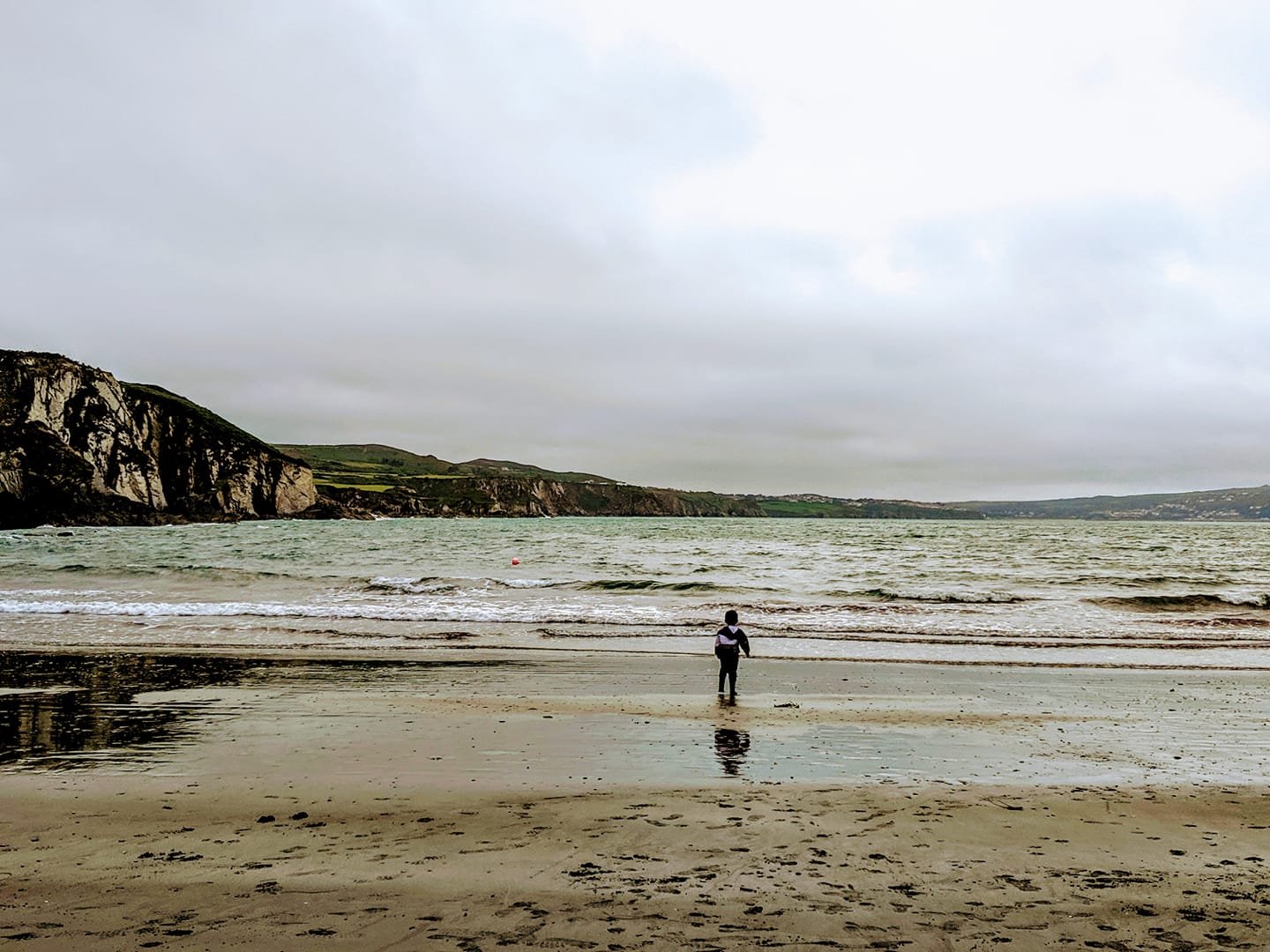
Photography by El-Jarn
-
El-Jarn, H., et al. (2025). Technology Anxiety in Virtual Reality Adoption: Examining the Impact of Age, Past Experience, and Cybersickness. IEEE Access, Vol. 13. ISSN: 2169-3536.
El-Jarn, H. & Southern, G. (2020). Can Co-Creation in Extended Reality Technologies Facilitate the Design Process? Journal of Work Applied Management, Vol. 12, Issue 2. ISSN: 2058-1114.
El-Jarn, H. & Sutcliffe, A. (2020). Investigating the Use of Social Media in Intimate Social Relationships. Behaviour & Information Technology, Vol. 39. ISSN: 0144-929X.
-
El-Jarn, H. (2024). The Veiled Selfie. MeCCSA Conference, Manchester.
El-Jarn, H. (2022). Visualising Storytelling in Social Media. UNIFEST Film Conference, Indonesia, 14 May 2022.
El-Jarn, H. (2018). The Impact of CMC on the Pashtun Diaspora. Digital Cultures: Knowledge / Culture / Technology Conference, Leuphana University Lüneburg, Germany.
El-Jarn, H. (2018). You Have Friends on Different Levels. CMCI Conference 2018: World in Flux, King's College London, 22 July 2018.
El-Jarn, H. (2011). Maintaining Long-Distance Relationships through Social Networking. Morgan Centre for the Study of Relationships and Personal Life, Proximities: Thinking About Relationality, University of Manchester, 14–15 September 2011.
Sutcliffe, A., El-Jarn, H., Jahu, H., Binder, J. & Byat, A. (2010). Use of Social Networking Technologies for Maintaining Social Relationships. 6th UK Social Networks Conference, Mitchell Centre for Social Network Analysis, University of Manchester, 14–16 April 2010.
El-Jarn, H. (2009). Maintaining Relationships, Social Networking and Computer-Mediated Technology. Manchester Business School Annual Postgraduate Conference, University of Manchester, 15–18 October 2009.
Practice-Based Research
“Dawn and the cool feel of the morning gently brushed my warm body, slumber disturbed by what seemed like a whirlwind of silent panic, everyone had vanished, just the disoriented memory of colourful ghostly cloth disappearing through my grandparents’ wooden doors…steam still curling up from their fresh tea, the wood fire still burning. My attention distracted by the disappearing colourful ghostly cloth floating out of the door, as if hypnotised by it.. beckoning me towards it.. in my Spiderman t-shirt and golden Aladdin pants I climbed down off the rope spun bed, the cold clay on the soles of my feet suddenly jolted me into panic and fear.. where have they all gone?.. they’ve left me?.. I ran out of the door, bare feet…in my red spiderman t-shirt and golden Aladdin pants.. running as fast as I could to catch the floating ghostly coloured cloths dancing in the morning dew… where were they taking me, I thought, as I began to run faster through twists and turns of clay housed confusion”
Project: Bare feet Pashtana
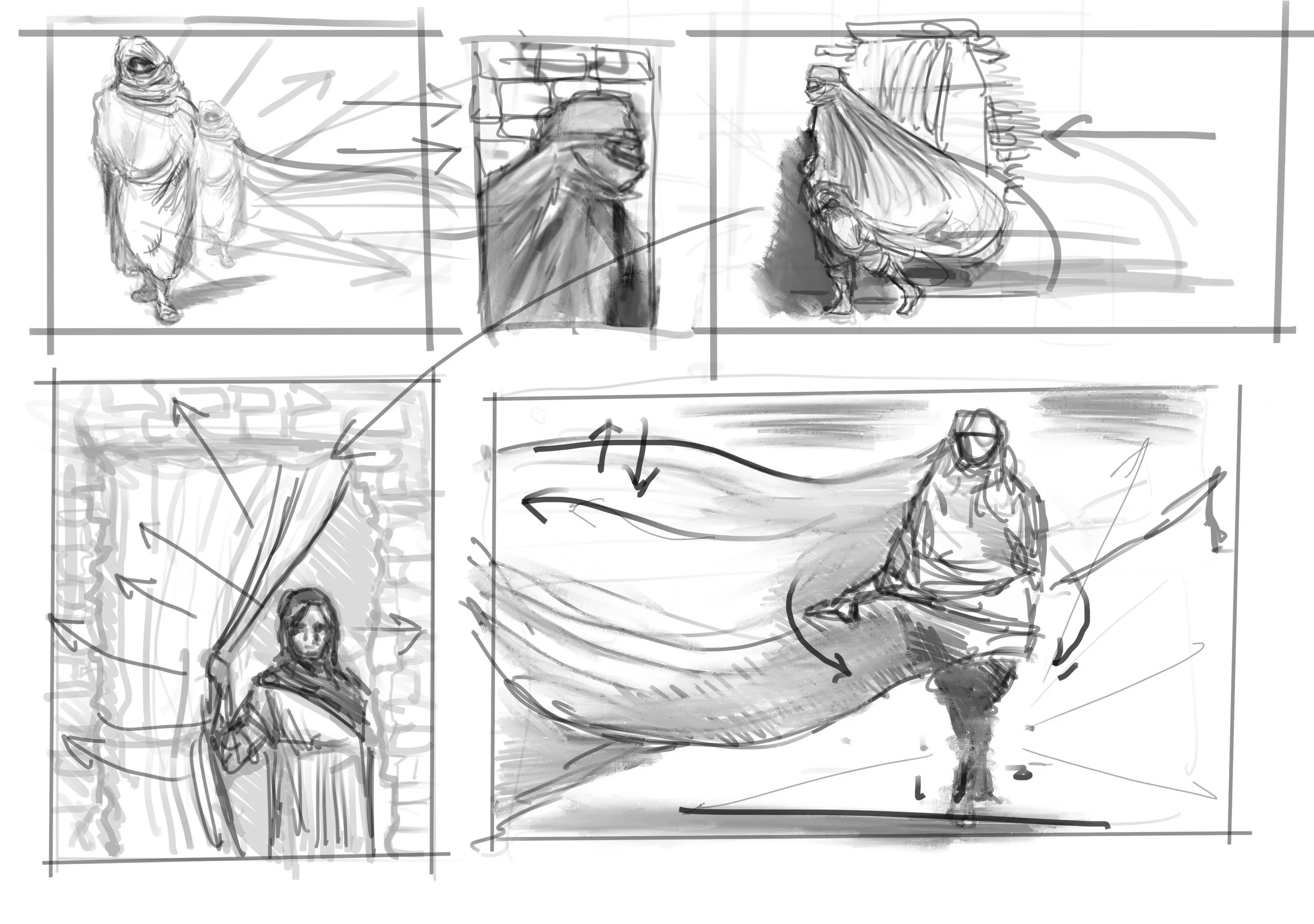
Bare Feet Pashtana is a practice-based immersive project rooted in memory, cultural heritage and personal narrative. It draws on my experiences as a British-Pashtun child who spent part of her childhood living within the tribal communities of the Afghan borderlands.
The project explores memories of childhood, family, landscape and displacement, offering a perspective that sits apart from the often narrow representations of Afghanistan and Pashtun culture found in mainstream media. Rather than attempting to tell a definitive story, the work uses personal memory as a starting point for exploring how lived experiences of culture, place and belonging can be represented through immersive media.
Developed through VR and spatial storytelling, Bare Feet Pashtana explores how memories can be reconstructed as experiences that audiences can move through and encounter. The project also forms part of my wider interest in using immersive and creative technologies to preserve cultural narratives and create space for stories that might otherwise remain undocumented.
The Veiled Selfie Project

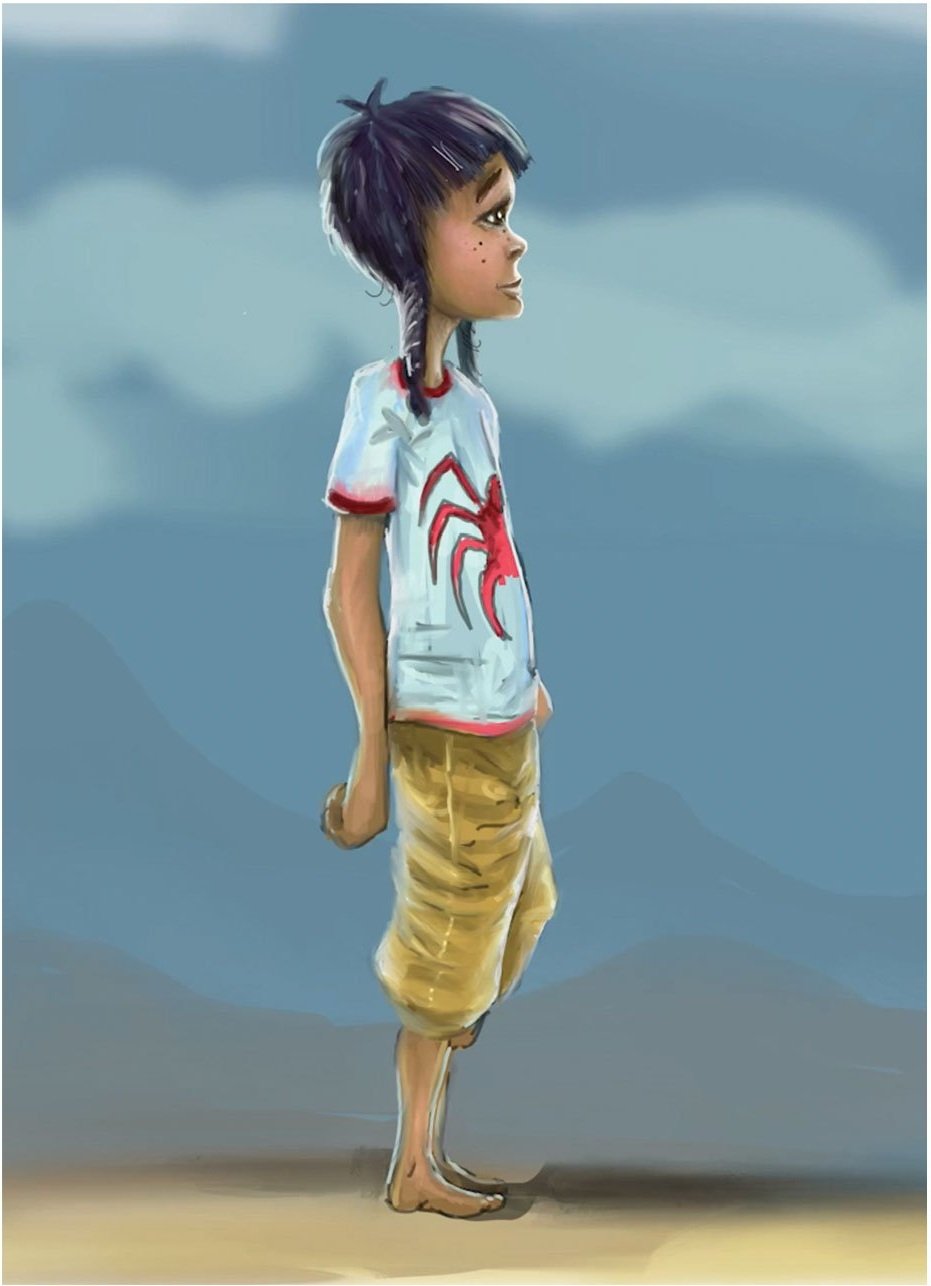
The Veiled Selfie Project explores identity, self-presentation and lived experience among women who wear the niqab. The project grew from my earlier research into the ways niqabi women use social media and the ‘selfie’ to express identity while maintaining the privacy of the face.
That research challenged the tendency for women who wear the niqab to be represented as a homogeneous group, particularly within political and media narratives. Online, a much more complex picture emerged, with women using clothing, place, objects, relationships and everyday moments to communicate different aspects of themselves and their lives.
The project has since developed beyond the original study into a wider programme of creative and practice-based research, working with niqabi women to explore their experiences in their own words and on their own terms. Through documentary film, visual storytelling and immersive media, the work considers how creative technologies can offer alternative ways of representing identity and making visible the individuality that can be lost within wider public narratives.
At its heart, The Veiled Selfie Project asks a simple question: what happens when we move beyond the veil and allow women to frame their own stories?

Capturing Echoes: Digital Archiving of the Pashtun Diaspora in the UK
STORIES OF THE ELDERS

Dedicated to Mr Saeed Ahmad - 1936 to 2021 UK resident since 1959.
Building on a strand of my PhD research, Capturing Echoes explores the experiences and histories of the Pashtun diaspora in the UK. My earlier research considered the development of ‘digital tribes’ and the role of communication technologies in maintaining relationships across geographically dispersed communities. Through that work, I became increasingly interested in the stories held by an older generation whose experiences risk being lost.
As a bilingual researcher, I am able to record these conversations in the language participants feel most comfortable using, allowing memories and experiences to be captured in their own words.
Using oral-history interviews, digital audio and photography, the project is developing an archive of personal accounts exploring migration, family, work, identity, loss and belonging. To date, I have recorded the stories of four elders — two men and two women — creating a collection that documents individual lives while contributing to a wider social and cultural history of the Pashtun diaspora in Britain.
The project is grounded in informed consent and ethical practice, with participants choosing how their photographs and stories may be shared. Ultimately, Capturing Echoes aims to preserve these histories for future generations while exploring how digital archives can support cultural memory, connection and storytelling.
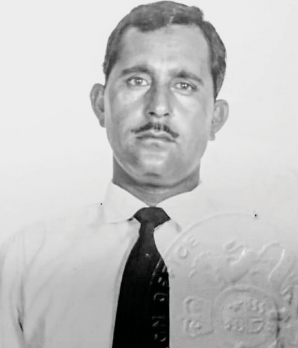
Captured: 1 hour audio footage 1953: While working for the British Royal Air Force Base in the Maldives

Captured: 2 hour audio footage 1972 - 1987: Loss of right hand, the skinheads of Sussex and life after disability

Captured: 1.5 hour audio footage 1939 - 1948: Childhood memories of family, loss and love